Bunbury’s Surf-Wave Climate
Bunbury is well known for its healthy surf-wave climate.
Generations of surfers have chosen to reside in Bunbury to enjoy the unique availability of quality surf within short proximity to modern life’s necessities, including a home, work and an active City centre. The local surf community can be observed enjoying the many unique surf-waves around Bunbury through Autumn to Summer, with some seasons even stretching through the usual Summer ‘flat spell’ when Bunbury’s coastal waters are perfectly calm for diving! The joy found by many surfers of Bunbury, and spread throughout the community after a good surf, does eventually wain as Bunbury’s coast undergoes these periods of poor-quality or no surf.
Bunbury’s southerly protected location, on the northern limits of Geographe Bay (33.3270° S), benefits from relatively calm winds below 15 knots, observed through multiple periods of the day and through the majority of months in the year. In fact, many mornings and evenings in Bunbury are observed experiencing a land breeze, gently directed offshore and below 10 knots. These liter, offshore winds increase surf quality conditions by reducing ocean surface micro-displacements (wind chop) while also increasing the circumference of plunging waves (tube hollowing). The wind conditions in Bunbury are actually much more favorable for most of the year than world-renowned surfing locations further south (Margaret River, Capes region). The surfing-favourable wind pattern may be attributed to Bunbury’s slightly lower latitude (respective of the sub-tropical ridge transition zone) or more likely due to marine-heat dissipation from Geographe Bay generating a mesoscale land breeze. Either way, these surf conditions are experienced and constantly discussed by generations of surf observers (the best type of computer model!) and reviewed in recent wave-climate and Artificial Surf Reef studies conducted for neighbouring beaches (Pattiaratchi & Wijeratne, 2019).
The consistent and powerful surfable waves present for the majority of the year (>80% of days). plunging-surging ‘shorey’ waves. The location receives consistent swell from all westerly directions, almost all year round, and focuses the marine energy along the Bunbury coast, through; swell diffraction around Cape Naturaliste, shoaling around and over the Bunbury paleo-valley western-ridge on approach to the Bunbury coast, and finally long-shore reflection (Figure 1).
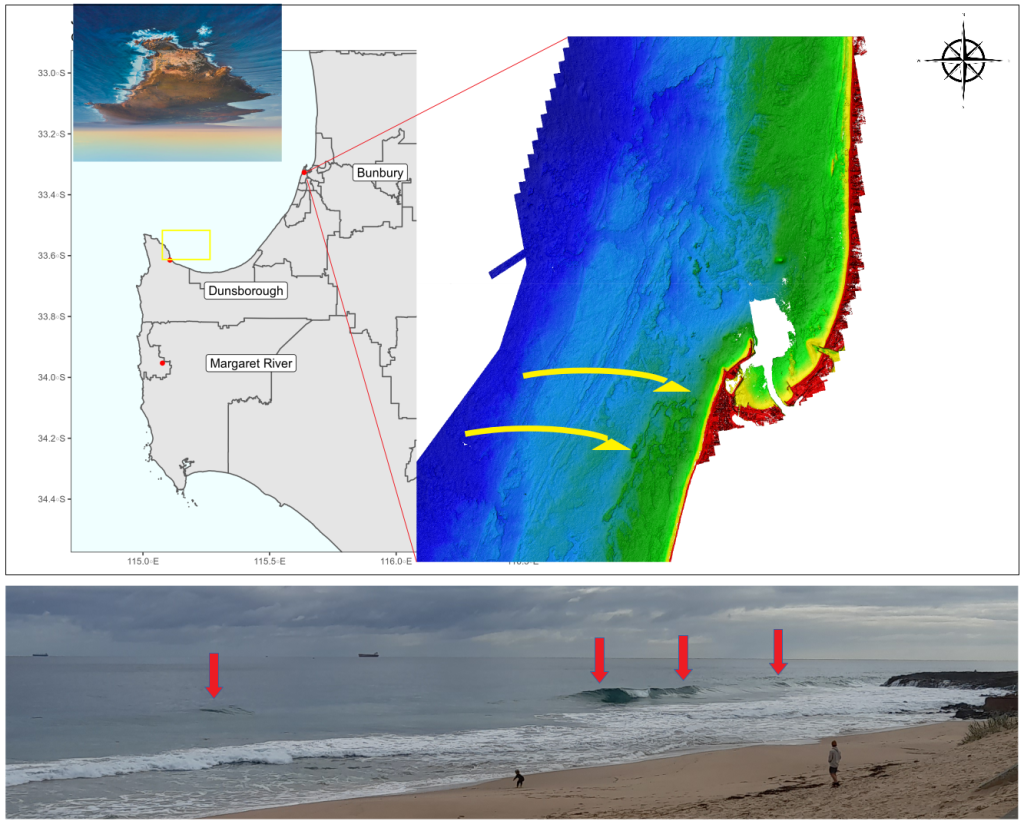
Figure 1: Wave dynamics on approach to the Bunbury coast. [top-left insert] Diffraction of gravity waves (long-period swell) from the Southern Ocean storm-belt around Cape Naturaliste, [top-right] shoaling over the paleo-valley bathymetry off the Bunbury coast with wave ray depicted in yellow, and [above] final reflection of shallow-water waves southwards depicted in red, right-to-left of image, at Sidewash, Back Beach, Bunbury.
Photographic image: Cape Naturalitse;property of Tim Campbell, https://www.timcampbellphoto.com/art-store/cape-naturaliste.
Indian Ocean sea’s and swell combine with longshore currents to generate sediment dynamics in which form wave-breaker sandbanks, producing surfable waves along the majority of Bunburys coast.
Bunbury’s western beaches and surf-waves evolve throughout the year. Isolated surfing breaks, including specific rock outcrops (Hungry Hollow, Whippys, BP reef’s, and Surf Club), natural and artificial headlands (Sidewash, Groyne & Fraggles, Bay and The Wall), and stretches of beach no longer than hundreds of metres (Hungry Hollow, Bay), each produce a diverse range of waves dependent on the seasonal meteo-ocean factors influencing the locations.
In general, the higher quality surfable waves at these locations alternate between dominant seasonal northern (north-south) and southern (south-north) currents and swell, and the sediment dynamics respective of these marine flows. Infra-gravity waves (wind and shorter period waves) do occur throughout the year, and do produce some fun quality surf, but do not compare relative to the larger, longer period swell waves generated during these two dominant seasonal marine states.
Bunbury’s surf waves in winter predominantly break right. The northern marine flows generating these waves arrive from origin storms in the central-west basin of the Indian Ocean, northwards of 20° below the equator. The cleanly formed and organised long-period gravity swell waves maintain the majority of their origin energy, un-impeded along their fetch, and maintain shoreline incident angles which favor low peel rates and longer peel lengths. The northerly winter waves in Bunbury are characterised as tall right-hand wave peaks with longer open-faced right-hand wave walls, conducive to higher quality surf waves in the area (Figure 3).
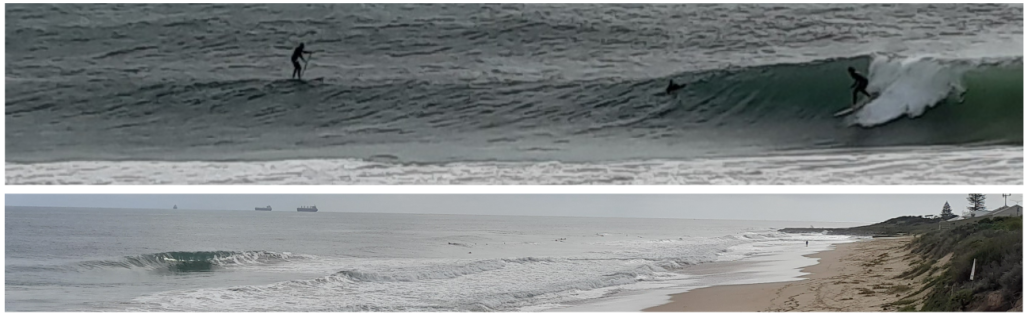
Figure 3: Images taken along Back Beach during northerly winter-swell (14:57:01hrs, 09 June 2021 & 11:04:11hrs, 11 June 2021, respectively: Q3 swell direction 314° @ SPorts Beacon #3) depicting right-hand wave peaks with distinct long, open, wave-faces peeling southwards (left of image).
The marine flows also aid in scouring inshore sediment, moulding the bathymetry with longshore transport and inshore deposition processes. The northern flows develop the inshore bathymetry over the winter season to further produce sandbanks which promote alignment with the northern swells, increasing ride length and surf quality in general, dependent on the the latitudinal and longitudinal origin of the storm (affecting swell direction and fetch, respectively). This developing process further contributes to inshore sediment dynamics, enhancing the sandbanks influence to surf quality, and producing longer right-hand rides with hollow ‘tubing’ wave sections which are desired by surfers above the intermediate level.
The alternate occurs the remainder of the year, with the southern flows advancing around Cape Naturaliste and refracting into Geographe Bay, re-directing deposition processes to produce predominantly longer and more consistent left-hand sandbank formations and waves (Figrue 4). The diffraction of these Southern Ocean swells around the Cape direct the majority of longer period surface-gravity swells to arrive in Bunbury from bearings of ~280° or greater.

Figure 4: Images taken from Fraggles Beach during southerly winter-swell (16:53:21hrs, 28 April 2021: Q1 & 3 swell direction 285° & 290.8° @ SPorts Beacon #3) depicting left-hand wave peaks with distinct long-open wave-faces peeling northwards (right of image).
Strong Southern Ocean swells regularly transmit through the prevailing northern winter marine flows, with intense austral winter storms generating large (+2 metres), long period (+16 second) swells that either dominate, or combine with the predominant northern winter swells and surf. These conditions create intense and variable surf along Bunbury’s coast that can be dangerous and only for the experienced surfer.
Ideally, the conditions most favored for surf in Bunbury is either one of the two dominant seasonal states, northern flows with long walled right-handers, or southern flows with long walled left-handers. The two dominant marine flows generally occur in Bunbury from northern currents occuring through winter from May to August, and southern currents which occur through summer from September to April. Other wave-types do of course occur within these dominant conditions, producing alternate wave-breaking directions to the general marine flow, such as large wedgeing waves formed from headland reflection (Figure 5).
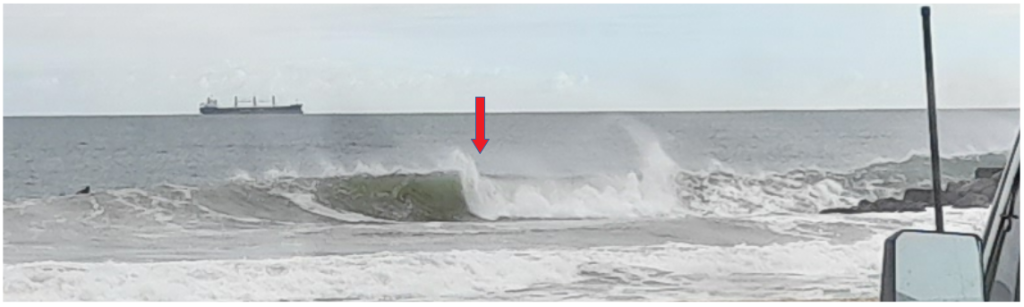
Figure 5: Images taken from the Groyne, during southerly winter-swell (10:13:14hrs, 11 July 2021: Median swell direction 296° @ SPorts Beacon #3) depicting constructive interference ‘wedging’ from headland reflection of SW swell. Note the wave-face height extreme at the apex of the broken wave peak, centre of image (red arrow).